
Ecommerce Development in Uganda: Online Stores Built to Actually Sell
An online store is only as good as its ability to turn a browsing visitor into a paying, returning customer — and in Uganda, that comes down to details many generic ecommerce builds get wrong: payment methods people actually use, a buying journey that respects limited data and patience, and enough visible trust to justify sending money before receiving a product.

An online store that looks good but doesn’t convert isn’t a small problem to fix later — it’s the entire business model failing quietly. In Uganda, the gap between a store that sells and one that doesn’t usually comes down to a handful of very specific things: can a customer actually pay you the way they want to pay, does the site load fast enough that they don’t give up and go back to Instagram, do they trust you enough to send money before receiving the product, and does the delivery process work smoothly enough that they come back and buy again.
At Website Design Uganda, ecommerce development is a distinct discipline from general website development, because an online store isn’t just a website with a shopping cart bolted on. It’s a full commercial system — product catalogue, inventory tracking, payment processing, order management, customer communication, and delivery logistics — all of which have to work together seamlessly, in a market with its own specific payment habits, trust dynamics, and delivery challenges that most generic ecommerce advice simply doesn’t account for.
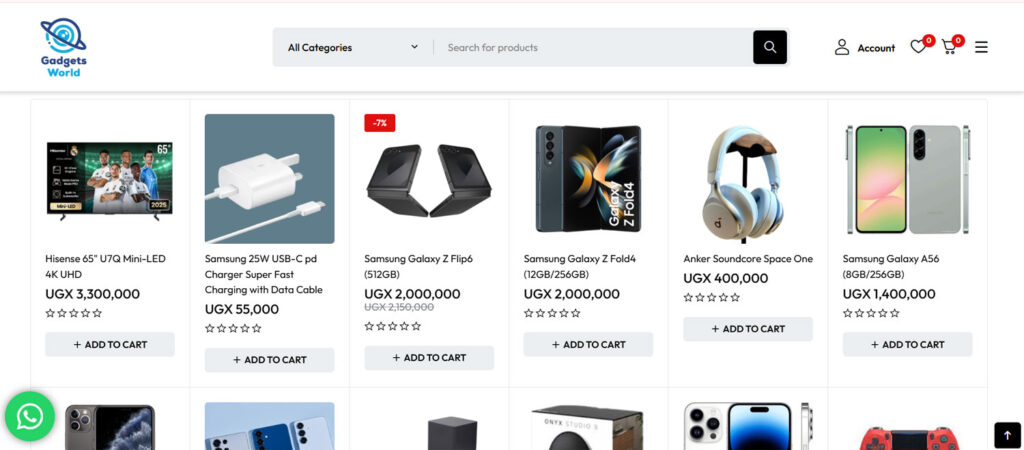
We build online stores for Ugandan businesses selling fashion, electronics, beauty products, food and groceries, furniture, agricultural inputs, and more — from a founder launching their first online shop to an established retailer moving from Instagram-only sales to a proper ecommerce platform that can scale. Some of the websites we designed are Gadgets World and Elite Tech Solutions, which are doing well, and more others.
Why Ecommerce in Uganda Needs a Different Build Than a Generic Online Store
Most ecommerce tutorials and templates are written with assumptions that simply don’t hold here: that every customer has a credit card, that a courier network will reliably handle last-mile delivery, and that customers already trust the brand enough to pay upfront online. None of those assumptions are safe defaults in the Ugandan market, and a store built without accounting for that reality will underperform no matter how attractive the product photography is.
Payment Behaviour Is Different
Mobile money is not a secondary payment option here — for a large share of customers, it is the primary and sometimes only method they’ll use. A store that treats mobile money as an afterthought bolted on beside a card payment form, rather than a first-class checkout option, is quietly turning away a large portion of its potential customers before they even reach the payment screen.
Trust Has to Be Built Into the Buying Journey
Sending money before receiving a product is a genuine leap of trust for a customer who’s never bought from you before. Clear product photography, visible business information, customer reviews, responsive WhatsApp support, and a transparent returns policy aren’t decoration — they are conversion features that directly determine whether a visitor becomes a paying customer or abandons the cart at the last step.
Delivery Is Part of the Product Experience, Not an Afterthought
In many markets, ecommerce development stops at checkout and hands the rest to a reliable courier network. In Uganda, delivery logistics — coordinating with boda riders, courier services, or your own delivery team, tracking orders, and communicating realistic delivery windows — has to be considered as part of the platform itself, because a smooth checkout followed by a confusing or unreliable delivery experience still results in a customer who never orders again.
Connectivity and Device Realities Shape the Build
Most shoppers will browse and buy from a mid-range Android phone on mobile data. A store with heavy, unoptimised product images, slow-loading category pages, or a checkout process that requires a stable connection for five uninterrupted minutes will lose sales to abandoned carts — not because the products weren’t wanted, but because the buying process asked too much of an imperfect connection.
Our Ecommerce Development Process
1. Product and Business Model Discovery
We start by understanding what you’re selling, how many products, whether inventory is tracked in real time or made to order, whether you need variants (size, colour, quantity), and how you currently manage orders — because these details shape the entire platform architecture, not just the visual catalogue layout.
2. Platform Selection
We recommend the right foundation for your specific business rather than a one-size-fits-all answer: WooCommerce for businesses that want strong content and SEO capability alongside their store, Shopify for businesses that want a fully managed platform with minimal technical maintenance, or a custom-built solution for businesses with unique inventory logic, B2B pricing tiers, or workflows that off-the-shelf platforms can’t cleanly support.
3. Store Architecture and Catalogue Structure
We plan categories, filtering, and search in a way that helps customers actually find products quickly — a disorganised catalogue is one of the fastest ways to lose a customer who arrived ready to buy but couldn’t find what they were looking for within a few taps.
4. Payment Gateway Integration
We integrate mobile money, card payments, and bank transfer options through providers such as Flutterwave and Pesapal, testing each payment path individually — including failure scenarios, like an interrupted mobile money prompt — so a technical hiccup during checkout doesn’t silently cost you a sale.
5. Inventory and Order Management Setup
We configure stock tracking, low-stock alerts, and order status workflows so you can manage the operational side of the business without drowning in manual spreadsheets or WhatsApp messages as order volume grows.
6. Delivery and Logistics Configuration
Depending on your business, we set up delivery zones and shipping cost logic, integrate with courier or delivery partners where applicable, and build in order tracking and customer notifications so buyers know what’s happening with their order after checkout — reducing the anxious “where is my order” messages that eat up your customer service time.
7. Mobile Optimisation and Speed Tuning
Product images are compressed and served efficiently, pages are built to load quickly on mobile data, and the checkout flow is streamlined to as few steps as possible — every extra step or every extra second of loading is a point where a customer can abandon the purchase.
8. Security and Trust Features
SSL encryption across the entire store, secure payment handling that never stores sensitive card data on your own server, visible trust signals like reviews and clear contact information, and a straightforward returns and refund policy are built in as standard, not offered as a premium add-on.
9. Testing
We test full purchase journeys end-to-end — browsing, adding to cart, applying discounts, checking out with each payment method, and receiving order confirmations — on real mobile devices and real network conditions, not just a fast office Wi-Fi connection.
10. Launch, Training, and Growth Support
We handle go-live, train you and your team on managing products, orders, and inventory, and remain available afterward for the inevitable questions and small adjustments that come with actually running a live store.
Features We Build Into Ugandan Ecommerce Stores
- Mobile money and card checkout, side by side as equal, first-class payment options.
- Product variants for size, colour, and quantity, with accurate stock tracking for each.
- WhatsApp integration for pre-sale questions and post-purchase support.
- Delivery zone and shipping cost logic tailored to how you actually deliver — in-house riders, third-party couriers, or pickup points.
- Order tracking and automated status notifications, so customers aren’t left guessing.
- Discount codes, bundles, and promotional pricing tools for campaigns and seasonal sales.
- Customer accounts and order history, encouraging repeat purchases without re-entering details each time.
- Admin dashboards for managing products, orders, and stock without needing a developer for routine updates.
- Reviews and ratings to build the social proof that drives first-time buyer trust.
- SEO-ready product and category pages, so your store can be found organically, not just through paid ads.
Ecommerce Platforms We Work With
There is no single “best” ecommerce platform — the right choice depends on your catalogue size, budget, growth plans, and how much day-to-day control you want over the technical side.
- WooCommerce (WordPress) — flexible, cost-effective, and strong for SEO-driven growth; a good fit for most small-to-mid-sized Ugandan retailers.
- Shopify — a fully managed, highly reliable platform with minimal server maintenance, well suited to businesses that want to focus purely on selling rather than technical upkeep.
- Custom-Built Ecommerce Platforms — for businesses with complex pricing structures, B2B and wholesale requirements, or unique operational workflows that standard platforms can’t cleanly accommodate.
We’ll recommend the platform that fits your business rather than pushing whichever one is easiest for us, and we’ll explain the trade-offs clearly so the decision is yours to make with full information.
Common Ecommerce Mistakes We See in the Ugandan Market
- Launching with card payment only, or mobile money added as a clunky afterthought, cutting off a large share of potential buyers immediately.
- Uncompressed, oversized product photos that make every page slow to load on mobile data.
- No clear delivery cost or timeline shown before checkout, leading to abandoned carts from customers unwilling to commit to an unknown total cost.
- Treating the store as “done” after launch, with no plan for adding products, running promotions, or maintaining security over time.
- No visible trust signals — no reviews, no clear contact details, no return policy — leaving first-time buyers hesitant to commit.
- Ignoring SEO entirely and relying purely on paid social ads, which stops generating sales the moment the ad budget runs out.
- Manual order tracking through spreadsheets or WhatsApp chats that becomes unmanageable and error-prone as order volume grows.
Ecommerce SEO: Getting Found, Not Just Built
A beautifully built store with zero organic search visibility depends entirely on paid advertising to bring in every single customer — an expensive, fragile way to run a business. We build ecommerce sites with SEO foundations from day one: descriptive, keyword-relevant product and category page structures, fast load speeds that satisfy Google’s ranking criteria, and clean, crawlable site architecture. For businesses that want to actively compete for high-intent shopping searches over time — things like “buy [product] online Uganda” or “[product] delivery Kampala” — this pairs directly with our dedicated Digital Marketing and SEO services.
Security and Trust for Online Payments
Customers handing over money to a store they’ve never physically visited are trusting your technical security as much as your product quality. Every store we build includes SSL encryption across all pages, PCI-compliant payment processing that never stores raw card details on your own servers, secure customer account handling, and regular backups — because a single security incident can permanently damage trust that took months of good service to build.

Scaling Your Store as You Grow
A store built to handle 20 orders a month needs different technical foundations than one built to handle 2,000. We design with growth in mind from the start — efficient database structures, caching for high-traffic periods like promotional sales, and hosting configurations that can scale — so a successful marketing campaign or viral moment becomes a growth opportunity rather than the moment your site crashes under its own success.
Ecommerce Categories We Build For
Different product categories carry different technical priorities, and we tailor the build accordingly rather than using one generic template for every store.
- Fashion and Beauty — variant-heavy catalogues (size, colour), strong visual presentation, and easy returns handling for fit-related exchanges.
- Electronics and Gadgets — detailed specification displays, warranty information, and comparison-friendly product pages for higher-consideration purchases.
- Food, Groceries, and FMCG — fast reordering, subscription or recurring order options, and delivery scheduling suited to perishable goods.
- Furniture and Home Goods — larger media galleries, delivery cost calculators based on size and location, and installment or inquiry-based purchase paths for high-value items.
- Agriculture and Agro-Inputs — bulk pricing tiers, seasonal stock management, and B2B ordering for farmers, cooperatives, and distributors.
- Handmade and Local Craft Goods — storytelling-focused product pages that support pricing based on craftsmanship rather than commodity comparison.
Why Choose Website Design Uganda for Your Online Store
An ecommerce build is one of the few web projects where a mistake doesn’t just look bad — it directly costs you money, order by order, for as long as it goes uncorrected. A checkout that fails silently for mobile money users, a delivery cost that only appears as a surprise at the final step, or a product page that takes too long to load on 3G isn’t a minor bug; it’s a lost sale that a customer experienced as your business letting them down, whether or not that’s a fair read of what actually happened technically.
Because our team handles design, development, and ongoing SEO under one roof, your store isn’t handed between separate providers who never talk to each other — the people who built your checkout flow are the same people who can fix it at 9pm when a payment gateway has an outage, and the same people who can tell you honestly why your product pages aren’t ranking on Google six months after launch. That continuity is what turns a store from a one-time project into a business asset that keeps improving over time.
Uptime, Speed, and Why They're Not Just Technical Details
Uptime — the percentage of time your website is actually reachable — and page speed are often treated as background technical metrics, but they translate directly into business outcomes. A site that’s down for even an hour during business hours can mean missed enquiries, failed transactions, and customers assuming you’ve closed permanently rather than simply experiencing a temporary hosting issue. Search engines also factor both uptime and speed into ranking decisions, meaning poor hosting doesn’t just risk occasional visible outages — it can quietly suppress your search visibility even when the site is technically online. A hosting plan with a strong uptime guarantee, genuine performance monitoring, and a provider that responds quickly to issues is not a premium extra; it’s a baseline requirement for a website your business actually depends on.
Frequently Asked Questions About Ecommerce Development in Uganda
How much does it cost to build an online store in Uganda?
Cost depends on catalogue size, required features, and platform choice — a straightforward WooCommerce store costs considerably less than a custom-built platform with complex inventory or B2B pricing logic. We provide a clear, itemised quote after understanding your specific requirements.
Can my online store accept mobile money payments?
Yes. We integrate mobile money as a core, first-class payment option alongside card and bank transfer payments, through trusted gateways such as Flutterwave and Pesapal.
How long does it take to build an ecommerce website?
A standard online store typically takes three to six weeks from discovery to launch, depending on catalogue size and required features. Custom platforms with complex functionality take longer.
Will my store work well for customers shopping on their phones?
Yes. Every store we build is mobile-optimised by default, since the large majority of Ugandan online shoppers browse and purchase from smartphones, often on mobile data.
Can you help with delivery and logistics, or just the website?
We build the technical systems — delivery zones, shipping cost logic, order tracking, and courier integrations where applicable — around how you actually fulfil orders. The physical delivery itself is typically handled by you, your own riders, or a courier partner, which we integrate into the platform.
Can I manage products and orders myself after launch?
Yes. You receive an admin dashboard for adding products, managing stock, processing orders, and running promotions, along with training so you’re not dependent on a developer for routine day-to-day management.
Do you offer ongoing support after my store is live?
Yes. We offer maintenance and support plans covering security updates, backups, and technical support, along with optional ongoing SEO and digital marketing services to keep driving traffic and sales after launch.
What’s the difference between using Shopify and building a custom store?
Shopify is a fully managed platform that’s fast to launch and requires minimal technical maintenance, well suited to standard retail businesses. A custom-built store makes more sense when you have complex pricing, wholesale/B2B requirements, or workflows a managed platform can’t flexibly support. We’ll advise honestly on which fits your specific business.
Can I sell both online and manage in-store or offline sales together?
Yes. We can configure your store so online orders, in-person sales, and stock levels stay in sync, rather than operating as two disconnected systems that require manually updating inventory in two places every time something sells.
Do you offer payment plans or phased builds for smaller budgets?
In many cases, yes. We can scope an initial launch with core buying functionality — catalogue, cart, and mobile money checkout — and add more advanced features like loyalty programmes or B2B pricing tiers in a later phase, so you can start selling without needing the full budget for every feature on day one.
Frequently Asked Questions About Domain & Hosting Services in Uganda
Should I choose a .co.ug or a .com domain for my business?
It depends on your audience — .co.ug signals a clear local Ugandan presence, while .com carries broader international recognition. Many businesses register both and point the secondary one to their main site, protecting the brand across both.
Who should own my domain name — me or my web developer?
You should always own your domain, registered under your own name or business details with an email address you control, even if a developer manages the technical setup on your behalf.
How do I check if I actually own my domain?
You can look up your domain’s registration details through a WHOIS lookup or by requesting registrar account access directly. If you’re unsure or can’t get clear answers, we can help investigate and, if needed, help you regain proper control.
What happens if I forget to renew my domain?
A lapsed domain can become available for anyone else to register after a grace period, potentially resulting in permanent loss of your business’s domain name. Setting up auto-renewal with a current payment method is the simplest way to avoid this entirely.
Is cheap hosting bad for my website?
Not always, but very cheap hosting is often overcrowded and under-resourced, which can lead to slower load times and unreliable uptime — a real cost if your website is important to your business. We help you choose hosting that fits your actual needs and budget without those hidden trade-offs.
Can you set up professional business email for my domain?
Yes. Business email hosting on your own domain is a standard part of a proper domain and hosting setup, and we configure it on your devices as part of the process.
Can you migrate my website from my current host to a better one?
Yes. We handle hosting migrations carefully to minimise downtime and preserve your existing website data, email, and, where relevant, your search engine rankings.
Do you offer ongoing hosting support, or just the initial setup?
Yes. Hosting management is available as part of our Website Maintenance & Support plans, covering monitoring, renewals, backups, and technical support well beyond the initial setup.
Can I move my domain to a different registrar later if I want to?
Yes, provided you’re the verified owner and the domain isn’t locked or within a restricted post-registration transfer window. This is one of the clearest practical reasons domain ownership should sit with you rather than a third party — it keeps that flexibility genuinely in your hands.
What’s included in a typical hosting package versus what costs extra?
This varies by provider and plan, but typically included are server space, SSL, and basic email accounts, while things like premium backup retention, a dedicated IP address, or advanced security monitoring can be plan-dependent extras. We’ll walk through exactly what’s included in any recommendation so there are no surprises later.
Web Design Services
Digital Marketing & SEO
Our Coverage

Start Selling Online the Right Way
Talk to Website Design Uganda for a free consultation and a clear quote for building an online store designed around how Ugandan customers actually shop, pay, and buy.